
KATADOKUORIGINAL
Place the nine elements by following the clues. There is only one solution.
View cases
KATADOKU
Logic challenges for anyone keen to test themselves
Katadoku can offer something different for those moments when we want to give students a challenge that invites them to slow down, read carefully and think before answering.
The challenges can be solved online or printed to work on paper. No sign-up and no preparation needed: just choose a Katadoku and start.
These logic games for the classroom can fit into very different moments of class and school life, especially when we offer them as an option for students who enjoy taking on a challenge.

Logic challenges don’t have to stay inside the classroom. At break time or in other spaces around the school, we can leave a Katadoku available to solve alone or with others. If we change them regularly, there will always be a new challenge to discover.

Not all students need the same amount of time to finish a task. For those who finish early, a Katadoku can be an alternative to doing more of the same exercises: a new challenge they can take on independently, on paper or online, while the rest of the group keeps working.

When a teacher is absent, a Katadoku can be one of the activities available during a cover lesson. It can be projected, handed out on paper or solved online, individually, in pairs or in small groups.
The whole class doesn’t need to take part: it can be offered as an optional activity, while anyone who prefers studies, does homework or gets on with other tasks.

A Katadoku can also become a shared challenge: we publish a puzzle, set a deadline and collect the answers. It can be organised between classes, in teams or for the whole school, with a small prize or some recognition, and can even become a regular activity, such as the Katadoku of the week or of the month.

When several students want to solve the same Katadoku, working on it together can be another way to play. Each person can suggest a deduction and explain which clue allows them to make it. That way we build the solution as a group, compare strategies and discover that we don’t always follow the same path to reach it.

Some Katadoku are built around stories and settings that can be linked to topics from class or school, such as Halloween or the environment. But there doesn’t always have to be a link: a challenge can also be a chance to step away from the usual content, discover other topics and face different situations while putting logic and reasoning into practice.
EDUCATIONAL PROJECTS
Turn selected Katadoku into a starting point for further learning in class: the environment, citizenship, languages and other topics, with guidance for teachers and ready-to-use activities.
Each Katadoku sets a small challenge that we have to solve using the information available. To find the solution, we need to connect information, rule out possibilities and review our decisions.


Starting from the clues, forming hypotheses and ruling out possibilities.

Interpreting each clue precisely and paying attention to detail.

Orienting, placing and relating elements on a grid.

Reviewing, trying other strategies and keeping going.
Not everyone approaches a logic challenge in the same way. Some students will find certain deductions quickly, while others will need more time, a little guidance or a chance to try different possibilities.
And not everyone will feel like solving a logic challenge at that particular moment. Whenever the activity allows it, we can present Katadoku as something to join in with, rather than just another task.
With practice, we discover new strategies and take on other challenges with more confidence. The idea is to spark curiosity, enjoy the puzzle and, for those who want to keep going, look forward to trying the next one.
Katadoku challenges are available in Spanish, Valencian, English and French, so we can also use them to set a challenge in another language. Understanding the clues properly becomes part of the challenge and lets us work on reading comprehension in a different context.


Katadoku isn’t a single type of game. The nine squares are the starting point for different ways of putting logic to the test.
Place the nine elements by following the clues. There is only one solution.
View cases
Reconstruct the route, find objects and make your escape.
View escapes
Analyse the clues and find the one correct solution.
View case files
Trace every line in one continuous stroke, without following the same line twice.
View strokes →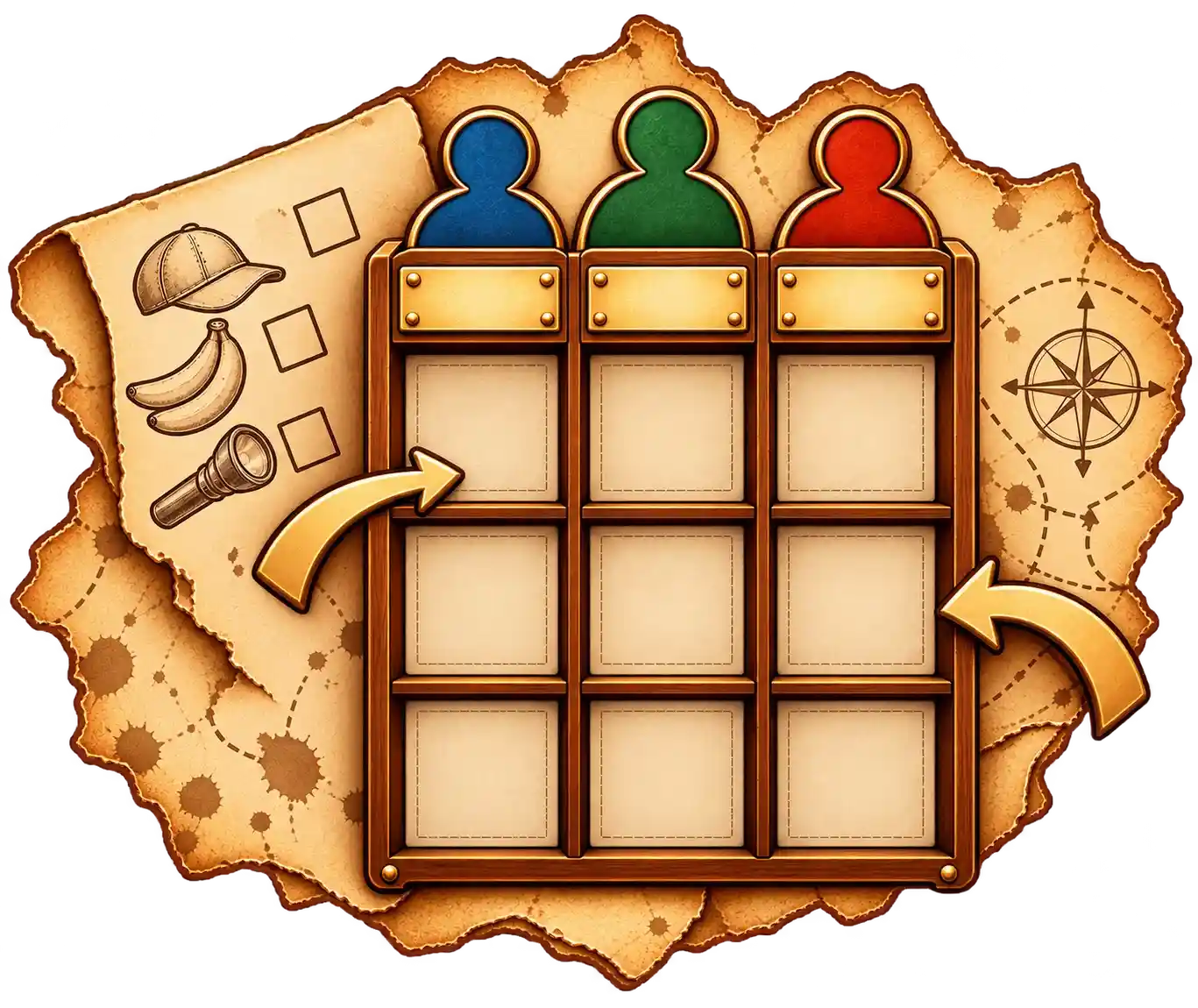
Sort the nine items into three groups using the clues.
View challenges →
Solve logic challenges based on the moves of chess pieces.
View challengesKatadoku challenges can be solved online or printed to work on paper.
Before starting, it’s important to understand the goal and how the game works. For some people, looking at the challenge will be enough; others will need to read the rules, see an example or clear up their first questions.
Once we know the game mode and its rules, it becomes easier to focus on the challenge itself and on the strategies for finding the solution.
The printable sheets contain all the information needed to tackle the challenge without showing the solution. We can use them individually, in pairs or as the starting point for a whole-class activity.
View printable logic games
Finding the answer can be just one part of the activity. We can also take the chance to talk about the process and ask questions such as:
This way, the challenge doesn’t end when we find the solution. Explaining the path we took is also part of the reasoning.
You don’t need to prepare a new activity to get started.
Choose a game mode, pick a Katadoku and make it available to anyone who wants to test themselves, online or on a printed sheet.
9 squares. Many ways of thinking.

